
After discovering the Lot Valley through its landscapes and villages, another layer begins to reveal itself — one that is deeply rooted in the land: the vineyards of Cahors.
Here, wine is not simply produced. It is shaped, gradually, by the rhythm of the river, the structure of the terraces, and the subtle variations in soil that define this part of southwest France.
To understand Cahors is not to memorise estates, but to follow the landscape itself — to see how each part of the valley expresses something slightly different, yet unmistakably connected.
Where the Cahors vineyards take shape
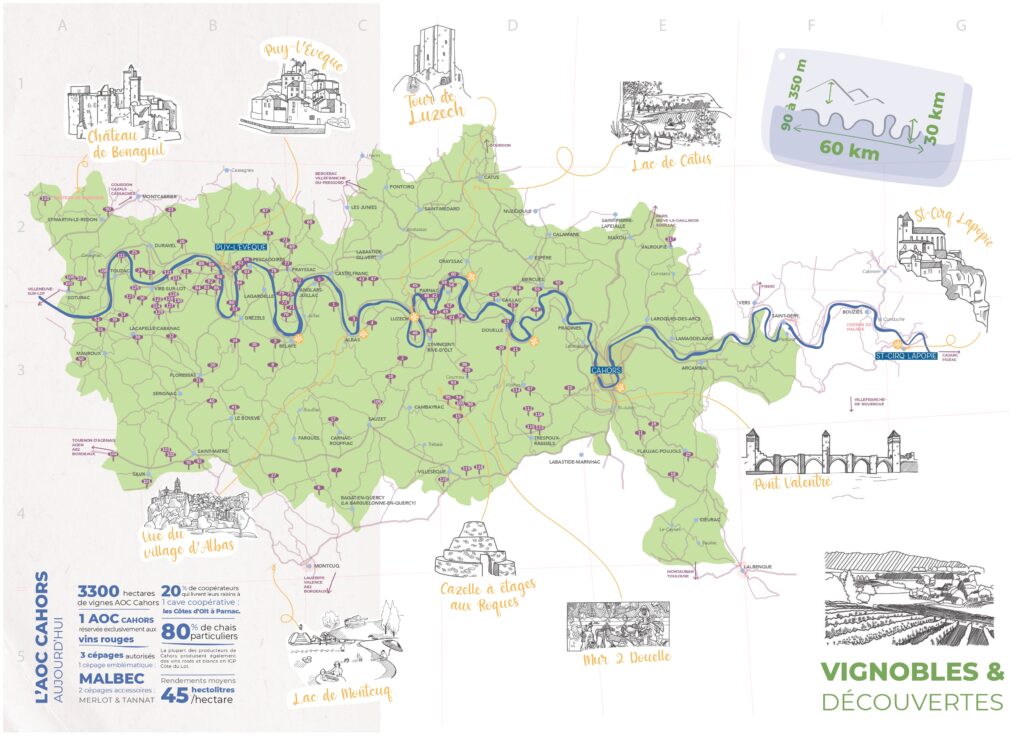
The Cahors vineyards are structured around the town of Cahors, at the centre of the Lot Valley, and extend across a broad landscape shaped by the river. The appellation stretches for approximately 48 kilometres from east to west, and up to 27 kilometres from north to south.
From this central point, the vineyard follows the course of the Lot River in both directions, unfolding as a continuous yet uneven presence.
To the east of Cahors, toward Saint‑Cirq‑Lapopie and Cajarc, the valley narrows and becomes more sinuous. Vineyards appear in smaller, more fragmented sections, closely following the curves of the river.
To the west, toward Puy‑l’Évêque, the landscape gradually opens. The vineyards become more extensive and continuous, forming the core of the appellation, where the structure of the terraces appears more clearly.
Cahors can therefore be understood as a vineyard organised around its centre, extending outward in two distinct movements — more concentrated to the west, more scattered to the east — shaped by the river, the relief, and the possibilities of the land.
A landscape shaped by terraces
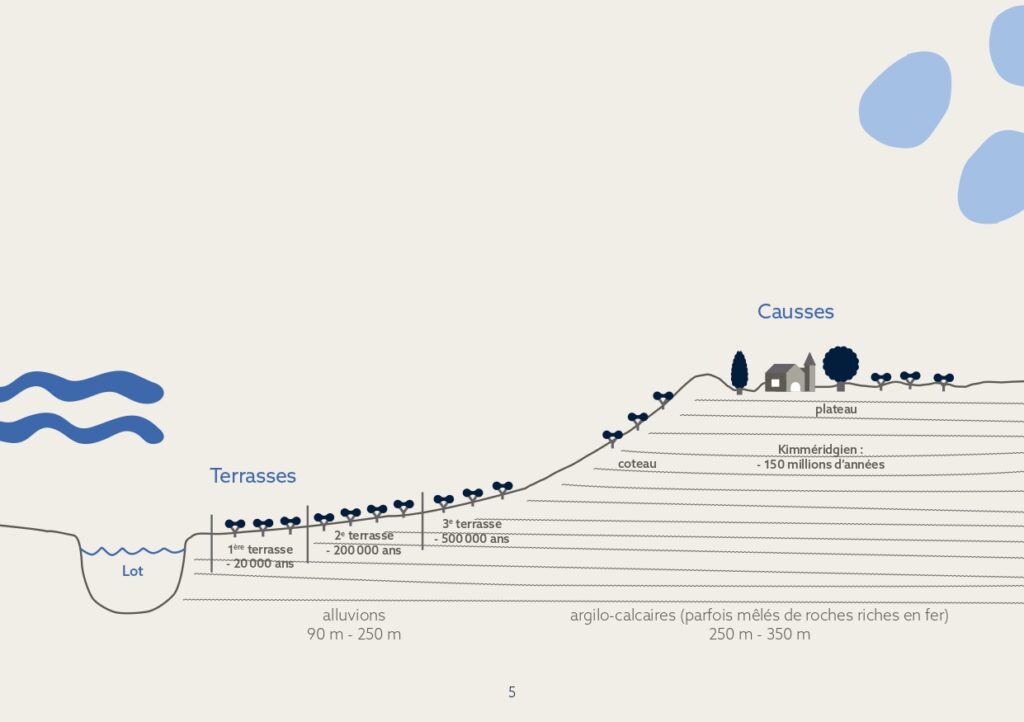
The vineyards of Cahors are built upon a system of terraces formed over time by the movement of the Lot River.
As the river carved its way through the valley, it created successive levels — gently rising from the riverbanks toward the higher ground. These terraces form the underlying structure of the vineyard, evolving in relation to the shape of the landscape.
To the east of Cahors, where the valley is narrower, these terraces appear in shorter and less continuous sequences, closely following the river’s curves.
Further west, as the valley opens, they unfold more steadily, forming a clearer progression from lower to higher levels.
From the lowest terraces near the river to the intermediate slopes and higher plateaux, each level reflects a different relationship to light, water, and elevation — shaping the character of the vineyard in subtle ways.
The soils beneath the terraces
Beneath these terraces lies a layered geological structure that defines the identity of Cahors.
Closest to the river, the lowest terraces are composed mainly of alluvial gravel, deposited over time. These soils retain warmth and allow for good drainage, often resulting in more open and accessible wines.
On the intermediate terraces, clay becomes more present, often mixed with limestone, giving greater depth and structure while retaining moisture.
Above these levels, the limestone plateaux emerge, where soils become thinner and more mineral, bringing freshness, tension, and precision to the wines.
This vertical organisation — from riverbank to plateau — creates a range of expressions within the same landscape, rather than a single uniform identity.
Malbec in Cahors: an expression shaped by place
In Cahors, Malbec finds one of its most deeply rooted expressions.
Yet the style does not reveal itself immediately. It reflects the landscape — structured, quiet, and often restrained in its early years.
There is a density to the wines, a depth that mirrors the soils and the presence of limestone beneath. But with time, this structure softens, allowing a more nuanced expression to emerge — one marked by balance, freshness, and quiet persistence.
On the lower terraces, wines tend to feel more generous and immediate.
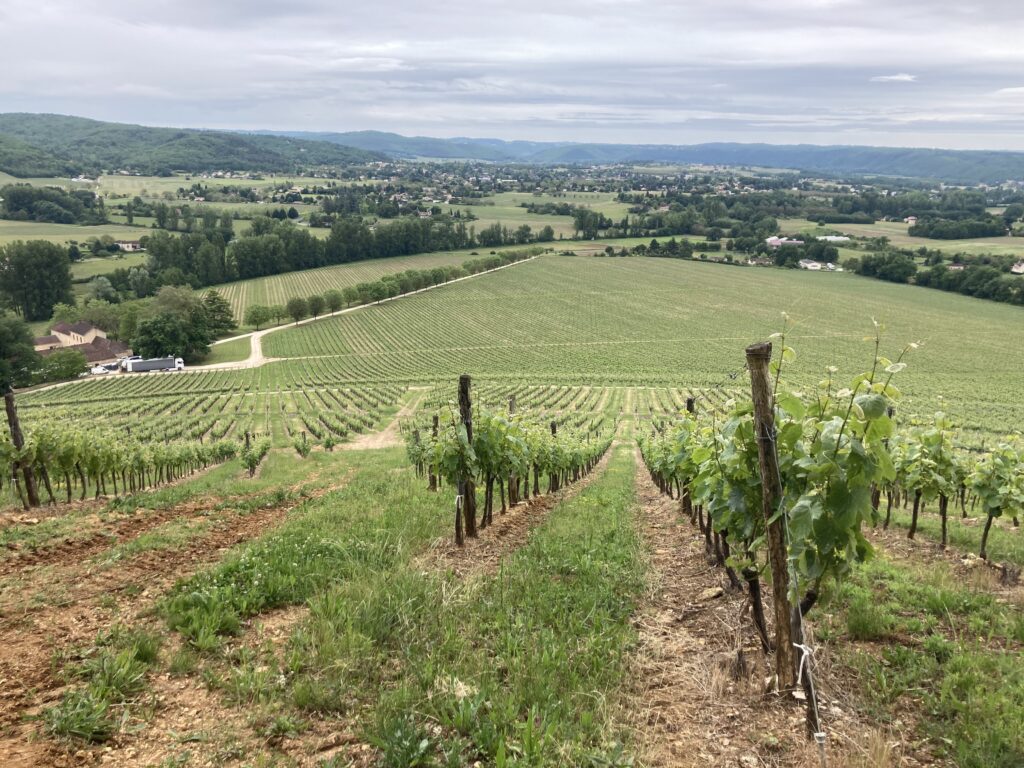
Higher up, as the soils become thinner and more mineral, they gain clarity and tension.
Rather than opposing styles, these differences can be understood as variations within the same landscape — different readings of the valley, shaped by altitude and soil.
To experience Malbec in Cahors is not simply to taste a grape, but to encounter the place that gives it form — a wine that reveals itself more fully when given the time it naturally asks for.
Experiencing the Cahors vineyards in this way is at the heart of the private wine tours offered by TraveLot.
Different expressions across the valley
As these elements come together, the Cahors vineyards offer a range of interpretations.
On the lower terraces, wines often feel softer and more immediate, while higher sites show greater precision and structure.
Certain estates reflect these variations particularly well.
At Château du Cèdre, the wines often express a balance between depth and finesse.
At Château Haute‑Serre, located on higher ground, the wines show structure and clarity shaped by elevation.
Further along the valley, estates such as Château Les Croisille highlight a more precise and contemporary expression of the terroir.
These are not comparisons, but illustrations — showing how one landscape can give rise to different, yet connected, expressions.
A vineyard best understood slowly
To move through the Cahors vineyards is not to visit as many estates as possible, but to allow the landscape to reveal itself.
The curve of the river, the change in light, the quiet transition between terraces — these elements shape the experience as much as the wine itself.
Here, wine is not separate from the place.
It is its natural continuation.
Understanding Cahors through its terroir
The Cahors appellation does not always reveal itself immediately.
It is a landscape that becomes clearer with time — through its terraces, its soils, and the quiet coherence of its valley.
For those who take the time to observe, the vineyards offer more than a tasting.
They provide a way of understanding the Lot Valley itself — its depth, its rhythm, and its understated presence.
To approach Cahors through its vineyards is to enter a more subtle dimension of southwest France.
A landscape shaped over time, expressed through wine, and best discovered with patience and attention.
This way of exploring — guided by place rather than by checklist — lies at the heart of the TraveLot perspective.
Explore Further
Learn more about the region:
- The Lot Valley: France’s Best-Kept Secret for Wine, Villages & Slow Travel
- The Villages of the Lot Valley: Quiet Places to Discover Beyond the Dordogne
- The Black Truffle of Southwest France: A Truffle Tour Through the Lot Valley
Experience it for yourself:
- Private Wine Tours in Cahors and the Lot Valley
- Signature Wine Tasting at Your Accommodation
- Truffle Experience in the Lot Valley
Pingback: Truffle Tour France: Discover the Black Truffle of the Lot Valley
Pingback: Truffle Season in France: When to Visit the Lot Valley