
The Lot Valley villages reveal a quieter side of southwest France, often discovered after visiting the Dordogne or Bordeaux.
The landscape begins to take on a more tangible form — not through major landmarks or defined routes, but through a series of villages that emerge along the river and across the surrounding hills.
These are not always places that impose themselves. Instead, they appear gradually — sometimes perched above the valley, sometimes folded into the land — offering a more discreet way of understanding the region.
Among them, several are recognised as “Les Plus Beaux Villages de France.” Yet here, this distinction feels less like a destination in itself and more like a reflection of something deeper: a continuity of place, architecture, and daily life that has remained quietly intact.
Villages that shape the character of the Lot Valley
In many regions, villages can feel curated or arranged for visitors.
In the Lot Valley, they tend to remain more grounded — shaped as much by local life as by their visual appeal.
The Lot Valley villages follow the contours of the terrain. Paths lead naturally toward the river, the church, or the square. And beyond the façades, there is a sense that these places are still lived in, rather than simply observed.
Each village offers its own presence, but together they create a landscape that is coherent and continuous — one that unfolds without interruption as you move through the valley.
A selection of villages to notice
Rather than an exhaustive list, these villages can be understood as entry points — different expressions of the Lot Valley’s quiet character.
Saint-Cirq-Lapopie
Often the first name that appears, Saint-Cirq-Lapopie occupies a dramatic position above the Lot River.
Seen from afar, it aligns with every expectation of a historic French village. Yet the experience shifts depending on the moment of the day.
Early in the morning or toward the evening, when the atmosphere softens, the village reveals something more subtle — less about its image, and more about its relationship to the surrounding landscape.
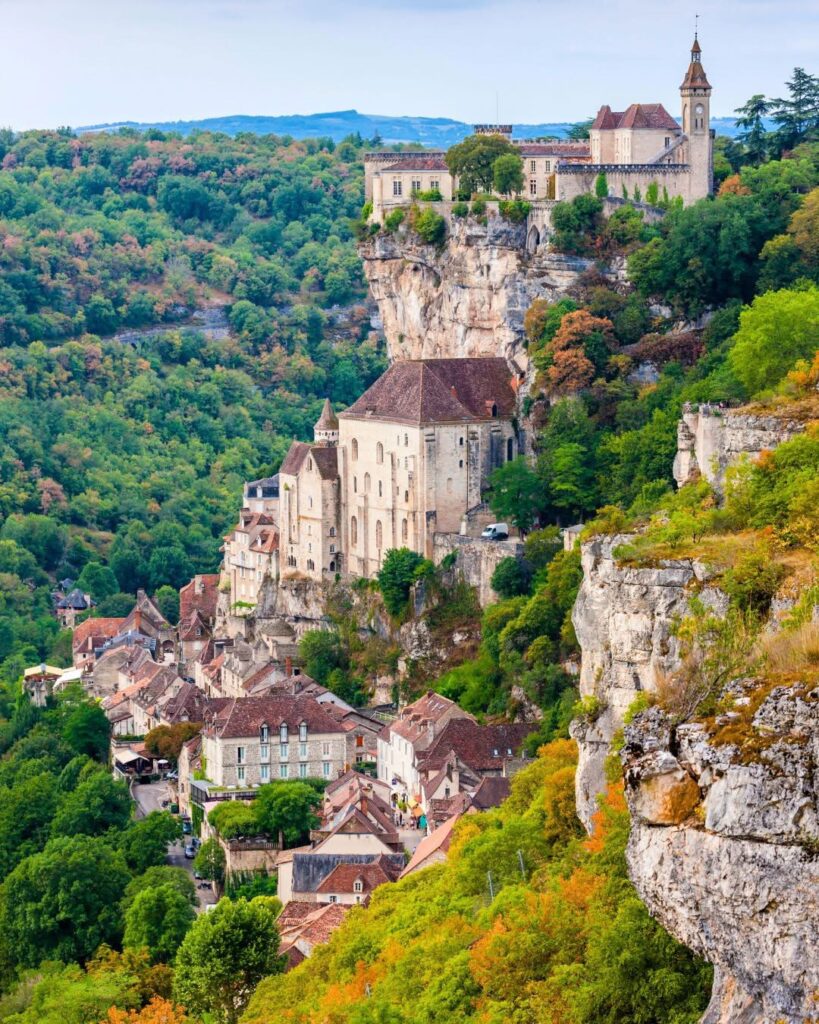
Rocamadaour
Rising vertically from the cliffs, Rocamadour feels distinct within the region — more monumental, more immediate.
And yet, beyond its initial impression, it is also part of the same broader rhythm.
Step away from the central axis, take the time to reach it outside the busiest hours, and it begins to reconnect with the quieter dimension of the Lot Valley.
Autoire and Loubressac
Located in close proximity, these two villages offer contrasting perspectives on the same landscape.
Autoire settles gently into a hollow surrounded by cliffs, almost enclosed, its presence closely tied to the natural formations around it.
Loubressac, by contrast, opens outward. Perched high above, it offers wide views across the valleys, with a sense of light and distance that defines the experience.
Carennac
Set along the Dordogne River, Carennac introduces another layer of quiet elegance.
Here, the architecture feels more linear, more aligned with the riverbank, creating a sense of continuity between built space and flowing water.
Martel
More structured, once an important trading town, Martel offers a slightly different dimension.
Arcades, stone façades, and a defined central square evoke a sense of history that is still present in the layout of the village.
Cardaillac
Further east, Cardaillac feels more discreet — less visited, and perhaps closer to the underlying character of the region.
What connects these villages
Despite their differences, certain elements remain constant.
There is always a strong connection to the surrounding land — whether through vineyards, limestone cliffs, or the river that defines the valley.
The scale remains human. The pace remains slow.
The Lot Valley villages are not organised around a single narrative or expectation. They are not presented as “must-see” destinations, but as places that continue to exist, independently of how they are perceived.
How to approach them
To move through these villages is not simply to visit them in sequence.
It is to allow space between them — to experience the transitions, the roads, and the perspectives that unfold along the way.
Arriving early, lingering slightly longer, or choosing quieter moments often changes the experience entirely.
Rather than seeking to see everything, the approach becomes more selective, more attentive.
A different way of discovering southwest France
For those who have already explored Bordeaux or the Dordogne, the Lot Valley villages offer something that is both familiar and subtly different.
They carry the same threads — history, architecture, rural life — yet express them with less intensity and fewer expectations.
It is not a question of finding “better” places, but of discovering them in another way.
To explore the villages of the Lot Valley is not to follow a defined route, but to enter a landscape that reveals itself gradually.
A place where each village adds a nuance rather than a highlight, and where the journey itself becomes as important as any individual stop.
Exploring the Lot Valley villages is often part of the private wine tours that combine landscapes, heritage and local encounters.
As explored in an earlier perspective on the region, the Lot Valley is often discovered after Bordeaux and the Dordogne, as a quieter continuation rather than a starting point — a context that shapes the way these villages are experienced.
Link on: earlier perspective on the region
These villages are not only shaped by architecture and history, but also by the surrounding landscape — particularly the vineyards that define much of the valley, offering another way of understanding the region through its terroir.
What I found most interesting is how different each village feels despite being part of the same landscape. The descriptions of Autoire, Loubressac, and Carennac especially made me curious to experience that slower pace and scenery.