The Lot Valley France is often discovered after visiting Bordeaux and the Dordogne — as a quieter extension of southwest France, less defined but no less compelling.
When travellers think of this part of the country, Bordeaux’s vineyards and the Dordogne’s villages come first.
Yet just beyond these familiar regions lies a landscape that feels more discreet, more open, and less structured: the Lot Valley.
Rather than competing with its neighbours, it reveals itself as a continuation — a place that becomes meaningful once the more well-known destinations have already been explored.
Where the Lot Valley sits
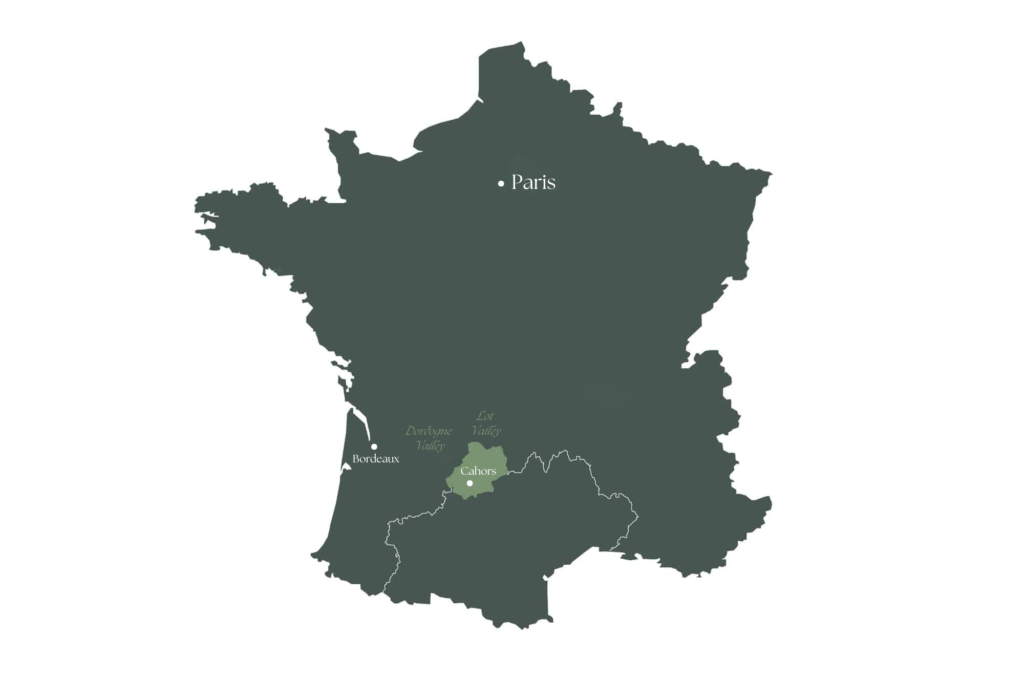
The Lot Valley extends along a gently winding river landscape in southwest France, centred around the town of Cahors.
Located to the east of Bordeaux and south of the Dordogne, it forms part of the same broader region, yet feels noticeably different in character.
For many travellers, this position matters. The Lot is rarely a first stop. Instead, it becomes relevant once Bordeaux or the Dordogne have already been experienced — as a natural next step in the journey.
Beyond well known regions — a continuation rather than a contrast
The Lot Valley is often described in relation to its neighbours, but this comparison can be limiting.
Rather than existing simply “near” Bordeaux and the Dordogne, it can be understood as what lies beyond them — both geographically and experientially.
Here, the familiar elements of southwest France remain: vineyards, stone villages, cultivated landscapes. But they appear in a quieter way, with fewer expectations and less formal structure.
The Lot Valley France does not seek to redefine these elements. It simply extends them, offering a more open and less interpreted version of the region.
A slower, less defined rhythm
What changes in the Lot Valley is not so much what you see, but how you experience it.
Distances feel longer.
Villages feel less arranged.
Daily life becomes more visible.
There are fewer “must-see” sites, fewer defined routes, and fewer explanations offered along the way.
Instead, the landscape reveals itself gradually — through a market in a small village, a quiet bend in the river, a vineyard conversation, or a view that seems to have remained unchanged.
For travellers used to more structured destinations, this can feel unfamiliar at first. But it is precisely this absence of structure that defines the experience.
Who the Lot Valley is for
The Lot Valley is not for everyone, and that is part of its clarity.
It tends to resonate with those who:
- have already explored Bordeaux or the Dordogne
- are looking for a slower, more grounded way of travelling
- prefer open-ended days rather than fixed itineraries
- are attentive to atmosphere rather than highlights
It may feel less suited to those seeking:
- structured sightseeing
- a concentration of major landmarks
- clearly defined travel routes
The Lot Valley France invites a quieter form of attention — less directed, but often more personal.
Why its location matters
What makes the Lot Valley particularly interesting is not only its landscape, but the role it plays in a wider journey through southwest France.
After visiting Bordeaux or the Dordogne, travellers often begin to look for something different: a slower pace, fewer reference points, and a more continuous relationship with the countryside.
In this sense, the Lot does not appear as an alternative, but as an extension — a place where the same cultural threads continue, but with less intensity and more space to experience them differently.
A place to understand rather than pass through
It is easy to travel through the Lot Valley and feel that little is happening.
The region does not impose itself. It does not organise your experience.
But for those who choose to stay longer and observe more closely, it begins to reveal something else entirely: a sense of continuity, a grounded presence, and a quiet, lasting impression.
Not because it is more spectacular than its neighbours, but because it invites a different way of being there.

For travellers curious about exploring southwest France beyond Bordeaux and the Dordogne, the Lot Valley becomes meaningful not as a first stop, but as what comes next.
This slower way of discovering the Lot Valley can be experienced through private wine tours designed to connect you with the region at a more personal pace.
Learn more about the region:
- The Villages of the Lot Valley: Quiet Places to Discover Beyond the Dordogne
- Cahors Vineyards: Discovering the Wine Heart of the Lot Valley
- The Black Truffle of Southwest France: A Truffle Tour Through the Lot Valley
Experience it for yourself:
- Private Wine Tours in Cahors and the Lot Valley
- Signature Wine Tasting at Your Accommodation
- Truffle Experience in the Lot Valley
As someone who lives in the Lot Valley, I really enjoyed reading this. You captured the calm and understated beauty of the region so well, and it was lovely to experience it from a new perspective. It made me appreciate everyday landscapes here in a different way. A wonderful first article and a thoughtful introduction to this corner of France.
Loved reading this. It gives the traveler coming to the Lot valley a sense of what it’s like to slow down and take it all in! Wonderful! Beautiful capture!